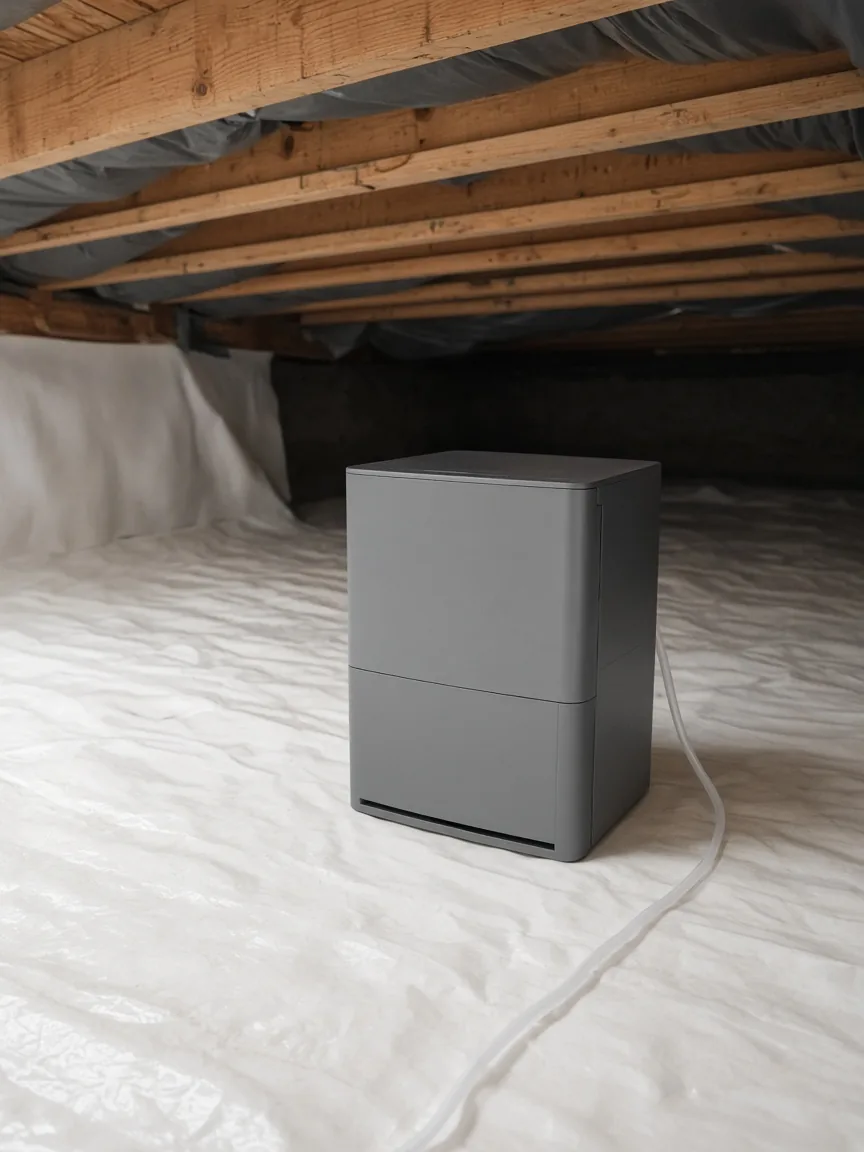
A crawl space dehumidifier in Kansas City keeps the air in a sealed crawl space dry enough to protect the framing, but it only works once the ground is covered, the vents are closed and liquid water is under control.
A dehumidifier is the last piece of an encapsulation, not the first. Put one in a vented crawl space over bare soil and it will run constantly against an endless supply of moisture. Put one in a sealed, covered space and it has a manageable job.
What humidity a crawl space should hold
The EPA's guide to mold and moisture recommends keeping indoor relative humidity below 60 percent, ideally 30 to 50 percent. That is guidance for indoor spaces, and it is a sensible target for a sealed crawl space that shares air with the house.
The reason humidity matters is the wood. Research from the USDA Forest Service's Forest Products Laboratory, Carll and Highley, found that decay fungi generally need wood moisture content above fiber saturation, usually about 25 to 30 percent, and that the long-standing rule is to keep wood below 20 percent moisture content. Wood framing absorbs moisture from humid air, so keeping the air dry keeps the joists below that line.
Why a dehumidifier cannot dry a vented crawl space
DOE's write-up on unvented, conditioned crawl spaces explains that in humid regions, outdoor air often holds more moisture than crawl space air. The DOE Building America Solution Center's guide to unvented, insulated crawl spaces adds that open vents let in warm, humid air that condenses on cooler joists.
With the vents open, a dehumidifier is trying to dry the outdoors. The National Park Service's moisture guidance, Preservation Brief 39, makes the related point that a dehumidifier and a ventilating fan should not run at the same time: one brings moist air in while the other tries to take it out. The fix is to close the vents and cover the ground first. See crawl space vapor barriers and vented vs sealed crawl spaces.
Dehumidifier, exhaust fan or conditioned air: the drying options
The DOE unvented crawl space guide says a closed crawl space needs a drying mechanism, such as a continuously running exhaust fan or a supply of conditioned air from the house's heating and cooling system. The guide cites section R408.3 of the 2009 International Residential Code and gives the conditioned air minimum as 1 cubic foot per minute per 50 square feet of crawl space floor.
A dehumidifier is a third way to keep a sealed crawl space dry. Which option suits your house depends on the ductwork, the size of the space, and how much moisture it still picks up after it is sealed. We choose with you after the inspection.
A store-bought unit or an installed crawl space unit
Plenty of people search for a dehumidifier and find a shelf of room units. Whatever unit goes under your house, check these things:
- Drainage. Does it drain continuously through a hose or pump, or does it need a bucket emptied? Nobody empties a bucket in a crawl space for long.
- Cool-air operation. Crawl spaces run cooler than living rooms. Some units are not designed to work well in cool air.
- Service access. Can someone reach the filter and drain without crawling across the whole space?
- Durability. Is it built to run for long hours in a damp, dusty space?
- Control. Can you set a target humidity, and can you see a reading from the house?
A unit built for a crawl space answers yes to all of these. A room unit may not.
Where it sits, where it drains, how it is powered
We place the dehumidifier where air can circulate around it and where someone can reach it for service. Condensate runs to a sump or a drain line, not onto the liner. The unit gets a dedicated outlet suitable for a damp space, with room left around it to change the filter.
Upkeep after it is installed
- Clean or change the filter on the maker's schedule.
- Check that the drain line is clear, especially after the first summer.
- Watch the humidity reading. A monitor you can read from inside the house tells you the system is working without a trip under the floor.
If humidity climbs and stays up, something has changed: a new leak, a torn liner, an open vent, or a unit that needs service. Persistent dampness can also bring back the musty smell covered on our mold and odor page.
Dehumidifier questions
Is it worth putting a dehumidifier in a crawl space?
In a sealed crawl space where humidity stays high after the liner and vent work, yes. In a vented crawl space, no: the vents keep supplying moist air, as DOE's guidance explains. Seal first, then dry. Our encapsulation page covers the whole sequence.
What is the fastest way to dry out a crawl space?
Stop the water first, then remove anything soaked, then dry mechanically. The DOE water management guide puts stopping water entry before anything else. The EPA guide says wet materials should be dried within 24 to 48 hours to limit mold.
What type of dehumidifier is best for a crawl space?
One that drains continuously, works in cooler air, is built for long run times in a damp space, and can be reached for service. We do not recommend brands on this page.
How much does a crawl space dehumidifier cost?
See our crawl space encapsulation cost page for published Kansas City ranges.
Sources
- U.S. Environmental Protection Agency, A Brief Guide to Mold, Moisture and Your Home
- USDA Forest Service, Forest Products Laboratory, Carll and Highley, Decay of wood and wood-based products above ground in buildings (1999)
- DOE Building America Solution Center, Unvented, Insulated Crawlspaces (updated 2021)
- DOE Building America Solution Center, Water Management of Existing Crawlspace Floor (updated 2015)
- U.S. Department of Energy, Unvented, Conditioned Crawlspaces, Building America Top Innovation (2014)
- National Park Service, Preservation Brief 39: Controlling Unwanted Moisture in Historic Buildings (1996)
Get a dehumidifier quote
Send photos of the crawl space, the vents outside, and any existing unit. Ask for a crawl space dehumidifier quote.