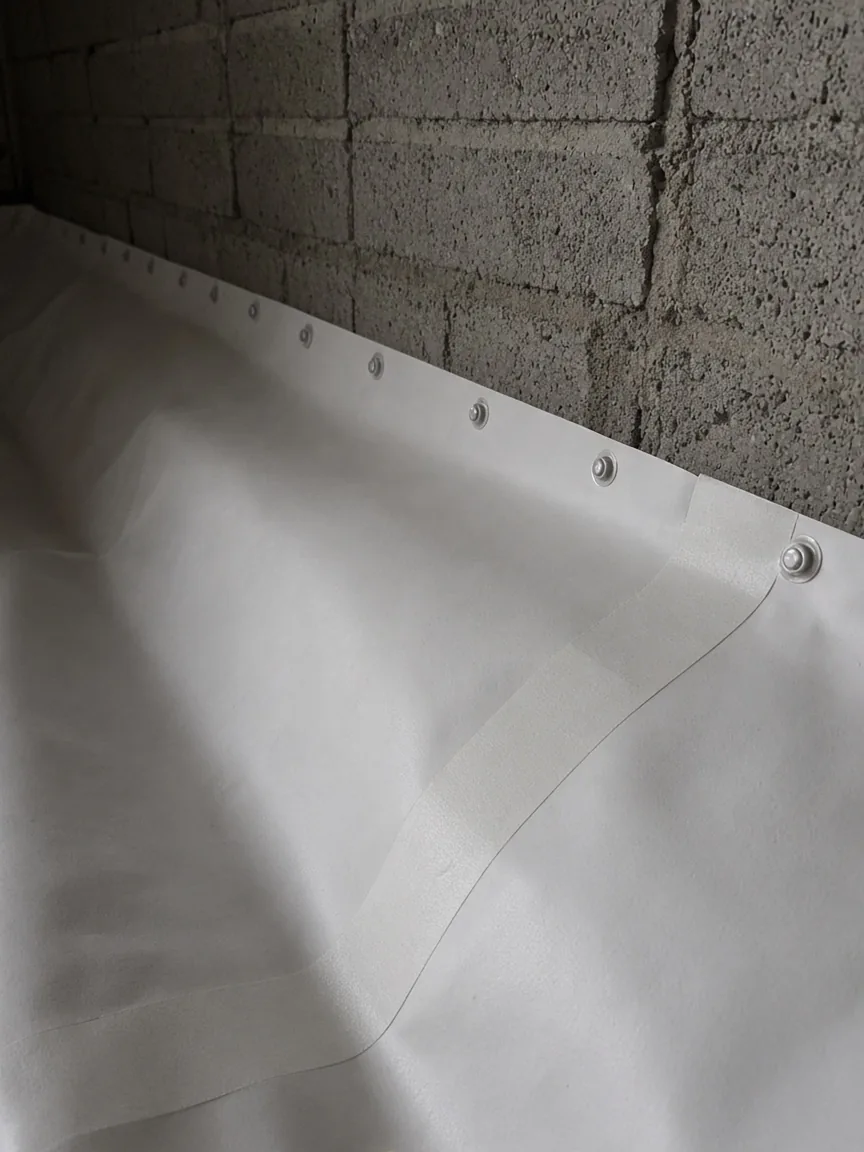
A crawl space vapor barrier in Kansas City is a sealed sheet of polyethylene over the soil that slows ground moisture from evaporating into the space under your floor, and it is one part of encapsulation, not the whole job.
Bare soil gives off moisture all the time, and that moisture ends up in the framing, the insulation and the air under your house. A well-installed barrier cuts that off at the source. A badly installed one, with gaps, loose edges and torn seams, does far less than it looks like it does.
Vapor barrier or full encapsulation: what each covers
A vapor barrier, or ground cover, covers the soil. In a vented crawl space it is the first moisture measure to get right.
Full encapsulation goes further. The liner covers the floor, runs up the walls and piers, and is sealed. Vents are closed, air leaks are sealed, the walls may be insulated, and a drying mechanism such as a dehumidifier or conditioned air keeps humidity in check. Our crawl space encapsulation page walks through every step.
Which one your house needs depends on whether the problem is ground moisture alone, or humid air coming through the vents as well. Our page on vented vs sealed crawl spaces helps with that decision.
How thick the plastic should be
Federal guidance sets a floor, not a ceiling. The DOE Building America Solution Center's guide to unvented, insulated crawl spaces calls for polyethylene of at least 6 mil, and its guide on water management of an existing crawl space floor gives the same minimum for a ground cover.
Thicker liners resist punctures better. That matters where people crawl across the liner to reach plumbing, ducts or a dehumidifier, because a torn liner lets moisture through. Thickness is a durability choice for your space, not a code number.
How a barrier is installed so it works
Coverage and sealing matter more than thickness. Following the two DOE guides:
- Full coverage. The liner covers the whole floor, with no bare soil left at the edges or around piers.
- Up the walls and piers. The unvented crawl space guide runs the liner up the walls to within 4 inches of the top of the foundation wall and up interior piers. The water management guide, for a ground cover in a vented space, runs it up walls and piers 8 to 12 inches or to exterior grade.
- Overlapped and sealed seams. The unvented crawl space guide recommends overlapping seams 12 inches and sealing them, and notes that the International Residential Code minimum overlap it cites is 6 inches.
- Fastened and sealed at the walls. Loose edges let soil moisture escape around the liner.
- A termite inspection strip. Where termites are a concern, the unvented crawl space guide leaves a 3 inch strip of bare wall at the top so the wall can be inspected.
- Radon. Where radon venting is needed, the guide says it goes under the liner, and local codes may have radon requirements.
How much difference a ground cover makes
The U.S. Department of Housing and Urban Development's Residential Rehabilitation Inspection Guide gives a rule of thumb for crawl space vents: a free vent area of 1 to 150 of the floor area over bare earth, or 1 to 1,500 when a vapor barrier of one perm or less covers the earth. In plain terms, covering the soil cuts the venting the guide calls for to one tenth. That is how much moisture bare soil adds.
What a vapor barrier does not fix
Humid air through open vents. DOE's write-up on unvented, conditioned crawl spaces explains that in humid regions, outside air often holds more moisture than crawl space air, so venting can bring moisture in. A ground cover does nothing about that. Closing the vents and adding a dehumidifier does.
Standing water. The water management guide says standing water means bulk water is getting in. Plastic laid over a puddle hides it and traps it. Read our guide on drainage before encapsulation first.
Replacing old loose plastic
Some older crawl spaces have a thin sheet of plastic that was laid loose decades ago and is now torn, bunched or buried. We remove it, along with debris on the soil, and look at what is underneath: wet spots, standing water, animal activity, or soil that slopes toward the walls. Anything wet gets addressed before the new liner goes down.
Vapor barrier questions
Is a 6 mil vapor barrier enough for a crawl space?
It meets the minimum in the DOE guides. Thicker material holds up better where people crawl over it to service equipment. We are not aware of any code requiring more, and we do not claim one.
Do you really need a vapor barrier in a crawl space?
Over bare soil, yes. HUD's rule of thumb shows a covered floor needs a tenth of the venting of bare earth, and the National Park Service's moisture guidance, Preservation Brief 39, lists a heavy polyethylene ground cover on exposed crawl space dirt as a recognized repair.
Can I lay plastic myself?
Yes, for a simple ground cover. What matters is full coverage, overlapped and taped seams, and edges sealed to the walls and piers, as the DOE water management guide describes. Full encapsulation, with sealing, wall insulation and a drying system, is a bigger job.
What does a vapor barrier cost?
It depends on the size of the space, the liner, and what needs fixing first. See our crawl space encapsulation cost page for published Kansas City ranges.
Sources
- DOE Building America Solution Center, Unvented, Insulated Crawlspaces (updated 2021)
- DOE Building America Solution Center, Water Management of Existing Crawlspace Floor (updated 2015)
- U.S. Department of Housing and Urban Development, Residential Rehabilitation Inspection Guide (2000)
- U.S. Department of Energy, Unvented, Conditioned Crawlspaces, Building America Top Innovation (2014)
- National Park Service, Preservation Brief 39: Controlling Unwanted Moisture in Historic Buildings (1996)
Get a vapor barrier quote
Send a photo through the access door showing the ground and any old plastic. Ask for a vapor barrier quote.