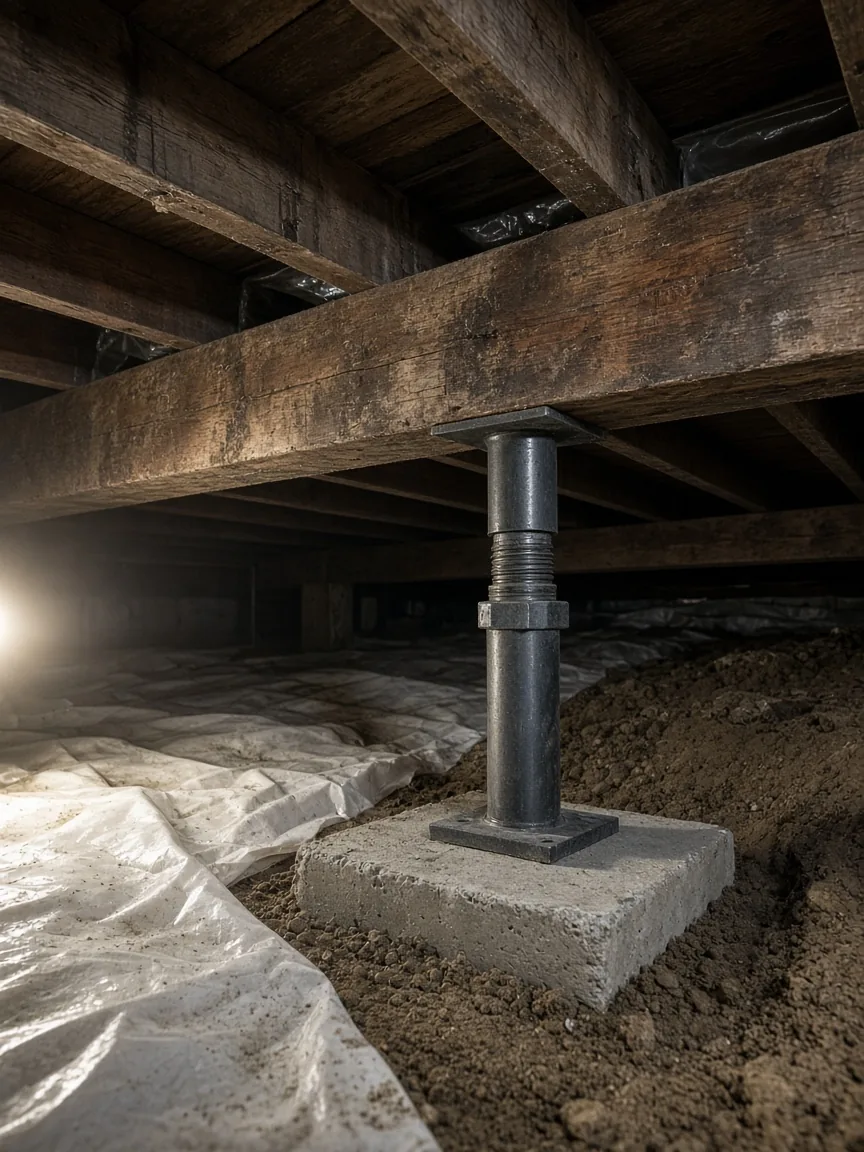
Crawl space repair in Kansas City covers two kinds of work under the house: moisture repairs such as drainage, liners, vent sealing and dehumidification, and structural repairs such as jacks, joists, beams and rotted sills.
The two are linked. Moisture weakens wood, and structural repairs made in a wet crawl space do not last. A good repair plan looks at both and does them in the right order.
What we check on a crawl space inspection
Our inspection follows the checklist in the U.S. Department of Housing and Urban Development's Residential Rehabilitation Inspection Guide:
- Dampness and standing water on the soil and walls.
- Fungal growth on framing, insulation and debris.
- Decay and insects, by probing sills, joists, beams, piers and columns.
- Insulation, whether it is in place, dry and in the right position.
- The vapor barrier, whether there is one and whether it covers the ground.
- Vents, how many, where, and whether they open and close.
- Access, which the guide says should be large enough for a person.
We also measure moisture in the framing where it looks suspect, and look outside at the downspouts and grade.
Moisture repairs
- Vapor barriers. A sealed liner over the soil slows ground moisture. See crawl space vapor barriers.
- Dehumidifiers and drying. A sealed crawl space needs a way to dry the air. See crawl space dehumidifiers.
- Vent sealing. In Kansas City's climate, open vents can bring humid summer air in. See vented vs sealed crawl spaces and why vented crawl spaces stay wet.
- Mold and odor. Moisture first, cleaning second. See crawl space mold and odor.
- Standing water. Drainage comes before anything is sealed. See drainage before encapsulation.
Together, these make up crawl space encapsulation.
Structural repairs
- Sagging floors. Adjustable steel jacks on proper footings, sistered joists and beam repairs. See sagging floors and crawl space jacks.
- Sill and rim repair. Sills and rim joists sit at the edge of the crawl space, closest to the outside, where water and insects reach them. Rotted sections are cut out and replaced with care, since they carry the walls above.
- Pier and post repair. Posts that have rotted at the base or settled, and piers that have cracked or shifted, are replaced or rebuilt on proper footings.
Fallen and wet insulation
Batts of insulation between the floor joists can soak up moisture, sag and fall. Wet insulation does not insulate and holds moisture against the wood. The DOE Building America Solution Center's guide to unvented, insulated crawl spaces says that in a closed crawl space, insulation goes on the walls as rigid foam, and none is needed on the crawl space ceiling. When we encapsulate, wet or fallen ceiling insulation comes out.
The order repairs should happen in
- Stop water entry. The DOE guide on water management of an existing crawl space floor puts drainage before sealing.
- Make unsafe structure safe. Support anything that is failing.
- Liner and sealing. Cover the soil, seal the walls, close the vents.
- Drying. Dehumidifier, exhaust fan or conditioned air.
- Monitoring. The water management guide recommends monitoring temperature, humidity and joist moisture, preferably for a year after the work.
Repairs that belong to another trade
Some problems under the house are not ours to fix, and we will say so:
- Plumbing leaks go to a plumber.
- Duct repair goes to the heating and cooling contractor.
- Termite treatment goes to a pest control company. Where termites are a concern, the DOE unvented crawl space guide leaves a 3 inch inspection strip of bare wall at the top of the liner.
We flag these on the inspection and coordinate so the work happens in the right order.
Crawl space access doors and hatches
HUD's inspection guide says a crawl space access opening should be large enough for a person. A small or blocked access makes inspection and service harder. Where the access is too small or the door has rotted, we can enlarge or replace it as part of the work.
Crawl space repair questions
Can you just fill a crawl space with concrete?
A thin concrete slab over a liner is an option the DOE guides mention for crawl space floors. Filling the crawl space solid is not something our sources support, and it would bury the plumbing, wiring and ductwork that run through it.
How do you repair a crawl space foundation?
It depends which part. Piers and posts inside the crawl space we repair or replace on proper footings. A perimeter foundation wall that is cracking or settling is a different job, and we will tell you if that is what we find.
What is the average cost of crawl space repair?
It depends on the repairs. See our crawl space encapsulation cost page for published Kansas City ranges for both moisture and structural work.
How long does crawl space repair take?
It depends on the scope: a liner alone is a shorter job than drainage, structural repair and full encapsulation. We give you a schedule with the written quote. More answers are on our FAQ.
Sources
- U.S. Department of Housing and Urban Development, Residential Rehabilitation Inspection Guide (2000)
- DOE Building America Solution Center, Unvented, Insulated Crawlspaces (updated 2021)
- DOE Building America Solution Center, Water Management of Existing Crawlspace Floor (updated 2015)
Get a crawl space repair quote
Send photos through the access door, of any sagging floor above, and of the vents and downspouts outside. Ask for a crawl space repair quote.