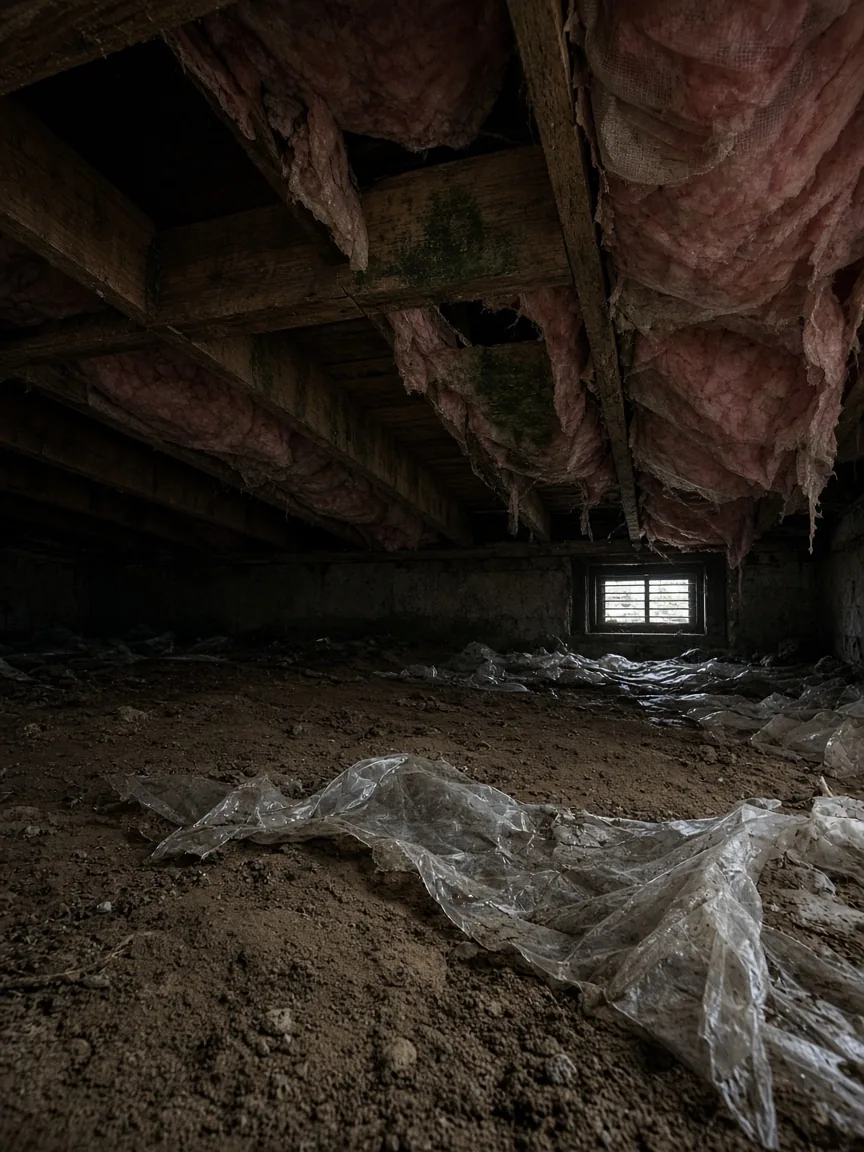
Vented crawl spaces stay wet in Kansas City because summer air here often holds more moisture than the cooler air under the house, so open vents bring humidity in and it condenses on joists, ducts and pipes.
The short answer
Vents were designed on the idea that outside air is drier than crawl space air. In a humid summer, the opposite is often true. Warm, moist air comes in through the vents, meets surfaces that are cooler than it is, and leaves water behind. The vents meant to dry the crawl space end up wetting it.
Kansas City's climate zone, in building terms
The U.S. Department of Energy's guide to determining climate regions by county places seven metro counties, Jackson, Clay, Platte and Cass in Missouri and Johnson, Wyandotte and Leavenworth in Kansas, in IECC climate zone 4A, which Building America classes as mixed-humid.
DOE defines mixed-humid as a region with more than 20 inches of annual precipitation, about 5,400 heating degree days or fewer, and an average monthly outdoor temperature that drops below 45 degrees Fahrenheit in winter. In plain terms: wet enough and warm enough in summer for humidity to be a building problem, and cold enough in winter for heating to matter too.
How humid air turns into water under your floor
Warm air can hold more water vapor than cool air. When warm, humid air cools, it can no longer hold all of that vapor, and some of it condenses into liquid water on whatever surface cooled it.
DOE's write-up on unvented, conditioned crawl spaces explains that in humid regions, outdoor air often holds more moisture than the crawl space air, so venting can lead to structural damage, mold and pest problems. The DOE Building America Solution Center's guide to unvented, insulated crawl spaces describes where it happens: the humid air condenses on cooler floor joists, and more so when the rooms above are air conditioned. Air conditioning cools the floor, the floor cools the joists, and the joists become the cold surface the moisture finds.
What federal research found when crawl spaces were sealed
DOE's Building America research program studied what happens when crawl spaces are sealed instead of vented. It found that unvented, conditioned crawl spaces cut heating and cooling energy use by 15 to 18 percent and reduced humidity by more than 20 percent. Those are findings from that research, not a promise for any particular house, but they show the direction: closing the crawl space to outside air made it drier, not wetter.
DOE notes that this research influenced the 2009 and 2012 International Residential Code, where section R408.3 permits unvented, conditioned crawl spaces.
What you will see in a wet vented crawl space
- Sweating ducts and pipes, with drops of water on cold metal in summer.
- Sagging or fallen insulation between the joists, heavy with moisture.
- Damp joists, sometimes with surface mold or dark staining.
- A musty smell upstairs, especially in humid weather.
If you see mold or smell mustiness, read crawl space mold and odor. If the floor above has started to dip or bounce, damp framing may be part of it; see sagging floors.
The winter side of the same vents
Vents also matter in winter. Oak Ridge National Laboratory's Foundation Design Handbook notes that in a vented crawl space, pipes and ducts need sealing and insulation, because the crawl space is open to cold outside air. Closing vents reduces heat loss, but closing them by hand each season takes steady attention.
"My vents have been fine for decades"
Some vented crawl spaces do fine, and it is worth knowing why. The U.S. Department of Housing and Urban Development's Residential Rehabilitation Inspection Guide gives a vent rule of thumb of 1 to 150 of the floor area over bare earth, but only 1 to 1,500 when a vapor barrier covers the earth. That tells you how much of the moisture load comes from bare soil.
The ORNL handbook calls venting a complement to a ground cover and drainage, not a cure-all. A crawl space on a dry site, with a good ground cover and no water problem, can do fine vented. The ones that struggle are the ones with bare or poorly covered soil, water getting in, or air conditioning cooling the floor above.
What to do next
If your vented crawl space shows the signs above, the next step is deciding whether to seal it. Read vented vs sealed crawl spaces for that decision, and drainage before encapsulation if there is water on the ground. Our crawl space encapsulation page explains the full sequence. More guides are on our guides page.
Sources
- U.S. Department of Energy, Guide to Determining Climate Regions by County (2015)
- U.S. Department of Energy, Unvented, Conditioned Crawlspaces, Building America Top Innovation (2014)
- DOE Building America Solution Center, Unvented, Insulated Crawlspaces (updated 2021)
- Oak Ridge National Laboratory, Foundation Design Handbook, section 3.1
- U.S. Department of Housing and Urban Development, Residential Rehabilitation Inspection Guide (2000)
Get your crawl space looked at
Send photos of the vents outside and the ducts, pipes and insulation inside. Ask for a crawl space encapsulation quote.