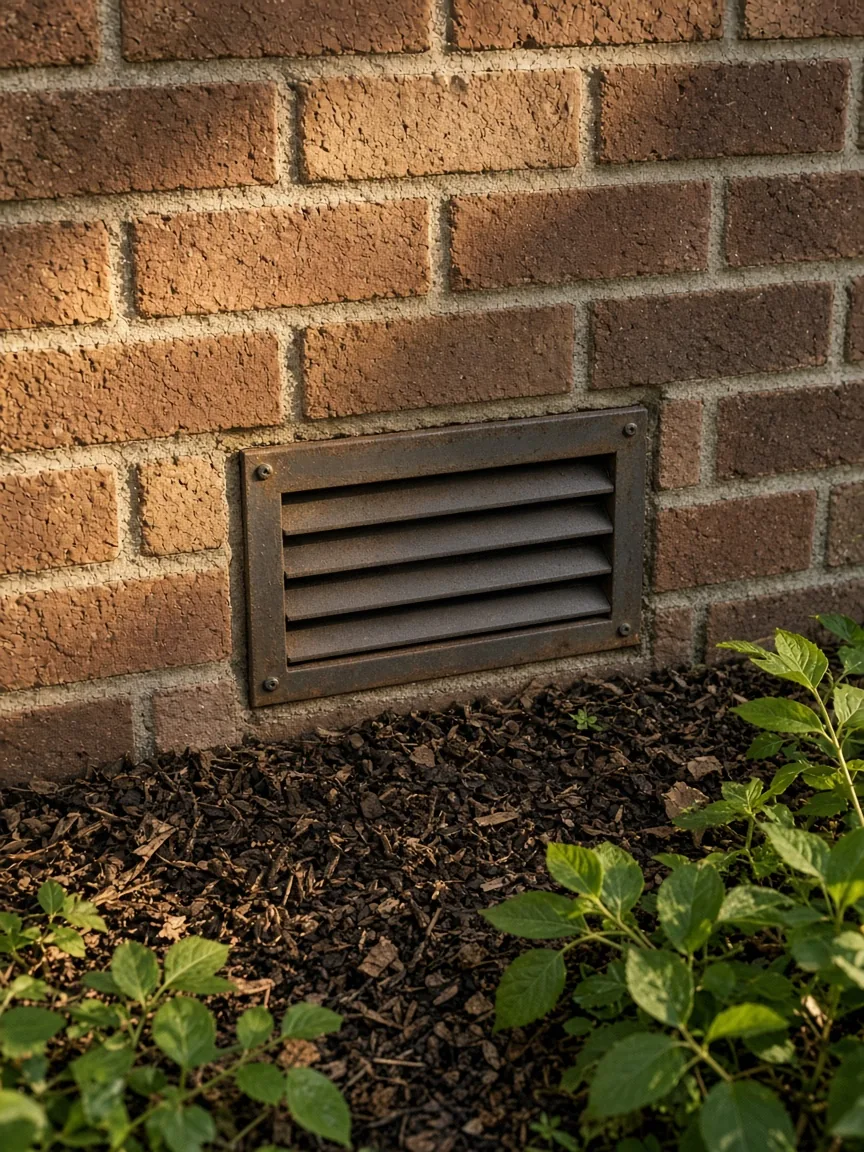
In Kansas City's mixed-humid climate a sealed crawl space generally stays drier than a vented one, because summer air coming through the vents often carries more moisture than the air already under the house.
The short answer
Seal it, if the water can be controlled and the space can be dried. Oak Ridge National Laboratory's Foundation Design Handbook says unvented crawl spaces are generally preferred except where flood risk is very high. A sealed crawl space needs a liner, closed vents and a drying mechanism to work. If those cannot be done, a vented crawl space with a good ground cover is the fallback, and this page explains how to run it.
Why houses were built with crawl space vents
The idea was reasonable. DOE's write-up on unvented, conditioned crawl spaces explains that vents were meant to control moisture on the theory that outside air would flush damp air out.
Venting rules were written around that idea. The U.S. Department of Housing and Urban Development's Residential Rehabilitation Inspection Guide gives a rule of thumb of a free vent area of 1 to 150 of the floor area over bare earth, with a vent near each corner. The trouble is the assumption behind it: that outside air is drier than crawl space air.
What happens under a Kansas City house in summer
DOE's guide to climate regions by county places Jackson, Clay, Platte and Cass counties in Missouri, and Johnson, Wyandotte and Leavenworth counties in Kansas, in climate zone 4A, classed as mixed-humid. DOE defines mixed-humid as more than 20 inches of annual precipitation, about 5,400 heating degree days or fewer, and an average monthly outdoor temperature that drops below 45 degrees Fahrenheit in winter.
In the humid part of the year, the DOE Building America Solution Center's guide to unvented, insulated crawl spaces explains that outdoor air can hold more water vapor than crawl space air. Open vents let that warm, humid air in, and it condenses on cooler floor joists, more so when the rooms above are air conditioned. The ORNL handbook adds that warm air drawn into a cool crawl space can promote mold and decay in floor joists. Our guide on why vented crawl spaces stay wet in Kansas City walks through this in more detail.
What a sealed crawl space needs to work
Following the DOE unvented crawl space guide:
- A liner of polyethylene at least 6 mil over the floor and up the walls and piers, seams overlapped and sealed. See vapor barriers.
- Closed vents and sealed air leaks to the outside.
- A drying mechanism, such as a continuously running exhaust fan or conditioned air, or a dehumidifier.
- Wall insulation as rigid foam, where insulation is used. None is needed on the crawl space ceiling.
- No combustion appliances drawing crawl space air. The guide warns against leaving low-efficiency heating equipment that takes its combustion air from the crawl space in a sealed one, and against storing gasoline or solvents there.
- A termite inspection strip of 3 inches at the top of the wall where termites are a concern.
Our crawl space encapsulation page lays out the full sequence.
What the building code allows in Kansas City, Missouri
Kansas City, Missouri adopted the 2018 International Residential Code for one and two family dwellings as part of its Building and Rehabilitation Code, according to the city's Information Bulletin No. 169. DOE's Building America write-up notes that its crawl space research influenced the 2009 and 2012 editions of the International Residential Code, where section R408.3 permits unvented, conditioned crawl spaces.
Other cities in the metro adopt their own codes, so we check the local rule for your address before the work is planned.
When a vented crawl space is still the right call
- Very high flood risk. The ORNL handbook makes this the exception to preferring unvented crawl spaces.
- Water entry that cannot be fixed. The DOE water management guide puts drainage before sealing. If the water cannot be stopped, sealing traps it. See our guide on drainage before encapsulation.
- Combustion equipment that cannot be changed and draws its air from the crawl space.
If you stay vented: vents open or closed, by season
Summer. The National Park Service's moisture guidance, Preservation Brief 39, says crawl space vents may be closed seasonally, including in summer when humid air is entering a cooled space. The ORNL handbook agrees that operable vents can be closed in summer to keep humid air out, but notes that it takes steady attention from the occupant.
Winter. Closing vents reduces heat loss through the crawl space. In a vented crawl space, the ORNL handbook says pipes and ducts need sealing and insulation.
Radon. The ORNL handbook notes that closing vents may increase radon entry.
The ground cover matters more than the vents. HUD's rule of thumb drops from 1 to 150 over bare earth to 1 to 1,500 with a vapor barrier of one perm or less. The ORNL handbook calls venting a complement to a ground cover and drainage, not a cure-all.
Vented versus sealed questions
Should a crawl space be sealed or vented?
In Kansas City's mixed-humid climate, sealed, when water can be controlled and the space dried. The ORNL handbook says unvented crawl spaces are generally preferred except where flood risk is very high.
What happens if a crawl space is not vented?
If it is sealed properly, with a liner, closed vents and a drying mechanism, nothing bad: that is how a sealed crawl space is meant to work. If vents are simply blocked over bare, wet soil with nothing to dry the air, moisture builds up. The DOE guide is clear that a closed crawl space needs a drying mechanism.
Should crawl space vents be open or closed in summer?
Closed, if humid air is coming into a cooled crawl space, according to Preservation Brief 39 and the ORNL handbook. It takes steady attention to manage vents by hand.
Should crawl space vents be open or closed in winter?
Closing them reduces heat loss, per the ORNL handbook. If the crawl space stays vented, pipes and ducts should be sealed and insulated.
At what temperature should crawl space vents be closed?
We do not give a temperature, because the trigger is humidity, not a number on the thermometer. When outside air is more humid than the air under the house, open vents bring moisture in.
Sources
- Oak Ridge National Laboratory, Foundation Design Handbook, section 3.1
- U.S. Department of Energy, Unvented, Conditioned Crawlspaces, Building America Top Innovation (2014)
- U.S. Department of Housing and Urban Development, Residential Rehabilitation Inspection Guide (2000)
- U.S. Department of Energy, Guide to Determining Climate Regions by County (2015)
- DOE Building America Solution Center, Unvented, Insulated Crawlspaces (updated 2021)
- DOE Building America Solution Center, Water Management of Existing Crawlspace Floor (updated 2015)
- City of Kansas City, Missouri, Information Bulletin No. 169 and Building and Rehabilitation Code
- National Park Service, Preservation Brief 39: Controlling Unwanted Moisture in Historic Buildings (1996)
Get advice on sealing your crawl space
Send photos of the vents outside, the ground inside, and any furnace or water heater in the crawl space. Ask for a crawl space encapsulation quote.