Sagging floors over a crawl space in Kansas City are fixed from below: we find out whether the joists, the center beam, the posts or their footings have failed, add adjustable steel jacks on proper footings or repair the wood, and deal with the moisture that weakened it.
A floor that dips or bounces is telling you something about the framing underneath it. The fix depends on which part has failed, so the first job is finding out. The second job is making sure the cause, such as moisture, does not undo the repair.
What the floor is telling you
- A dip in the middle of a room.
- A floor that bounces or feels springy when you walk across it.
- A slope toward the center of the house.
- Gaps opening under baseboards or between the floor and the wall.
- Interior doors that start to stick or swing on their own.
- Cracks in drywall or plaster above interior doorways.
The U.S. Department of Housing and Urban Development's Residential Rehabilitation Inspection Guide says springy or sagging floors call for a look at the wood framing below.
The usual culprits under the floor
Under a sagging floor, we look at each part of the load path:
- Posts that have settled, rotted at the base, or were never set on a proper footing.
- The beam that carries the middle of the floor, if it is undersized, split, or decayed.
- Joists that have been notched or cut for plumbing or ducts, or that have decayed.
- Sills and rim joists around the edge, which sit closest to the outside and can be damaged by water and insects.
A loose block or a short stack of bricks under a beam is a shortcut we find from earlier repairs. It is not a footing, and it can explain a floor that has kept sinking.
When damp wood becomes weak wood
Wood loses strength as it decays, and decay needs moisture. Research from the USDA Forest Service's Forest Products Laboratory, Carll and Highley, found that decay fungi generally need wood moisture content above fiber saturation, usually about 25 to 30 percent, and that the long-standing rule is to keep wood below 20 percent.
That is why we measure. HUD's inspection guide says sills, joists, beams, piers and columns should be probed for decay and insects. The DOE Building America Solution Center's guide on water management of an existing crawl space floor recommends monitoring the moisture content of rim and floor joists after crawl space work. A probe tells us whether the wood is sound. A moisture meter tells us whether it is at risk.
What crawl space jacks do, and what they need under them
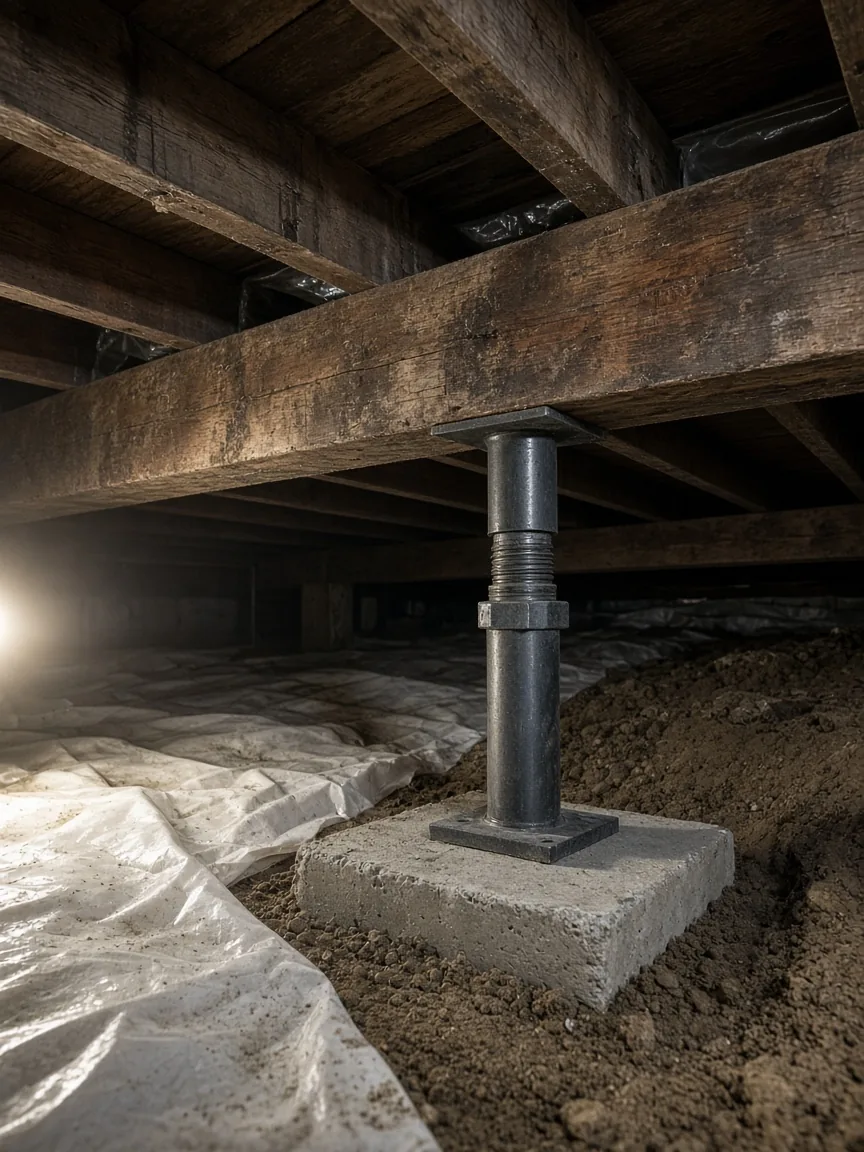
A crawl space jack is an adjustable steel post. It sits under the beam, carries part of the floor's load down to the ground, and can be adjusted to raise or support the beam.
The jack is only as good as what is under it. A permanent jack sits on a proper footing that spreads its load into the soil. A jack set on bare dirt, on a loose block, or on the liner can sink just like the posts it replaced. We set each jack on a footing sized for the job, and we place jacks where the beam and the floor above need support.
Sistering joists and repairing beams
Sistering means fastening a new joist alongside a damaged or weak one, full length or across the damaged section, so the two share the load. It is the standard repair for a joist that has been notched, cracked, or partly decayed but is still in place.
Beam repair depends on the damage. A split or decayed section can be reinforced or replaced. An undersized beam may need more support points beneath it. Where a beam has rotted at a bearing point, that section is replaced and the cause of the wetness is fixed.
Rotted sills and rim joists are cut out and replaced, which is careful work because they carry the walls above. Our page on crawl space repair covers sill and rim repair alongside the other structural work.
How far a floor can be raised
A floor that has sagged over many years has settled the house around it: drywall, trim, cabinets, doors and tile have all adjusted to the sag. Lifting it back too fast can crack those finishes.
We raise in stages, watching the finishes and the framing as we go, and we stop when either tells us to. Sometimes that means a floor that is much better rather than perfectly level. We do not promise a level floor before we have seen what the house will tolerate.
Which comes first, the structure or the moisture
If part of the floor is unsafe, we stabilize it first. Then we fix the water and humidity so the repair lasts. New jacks and sistered joists in a wet crawl space are sitting in the conditions that failed the original wood. Encapsulation protects the repair. See our crawl space encapsulation page and our guide on drainage before encapsulation. If the framing has mold on it, also read crawl space mold and odor.
When a sloping floor is not a crawl space problem
If the floor slopes toward an outside wall rather than toward the middle, and the outside foundation wall itself is cracked or settling, the problem may be the perimeter foundation, not the framing in the crawl space. That is a different job, and we will tell you if that is what we find.
Sagging floor questions
How can I reinforce floor joists in my crawl space?
Sistering a new joist alongside a weak one is the standard approach, along with adding support under the beam where it spans too far. A temporary jack on a loose block is not a repair. Any lasting support needs a proper footing.
How much does it cost to lift a sagging floor?
It depends on how many support points are needed, the condition of the wood, and access. Our crawl space encapsulation cost page includes a published Kansas City range for sagging floor repair.
Will encapsulation fix my sagging floor?
No. Encapsulation controls moisture. It protects a structural repair and helps keep wood from decaying further, but it does not lift a floor. See our encapsulation page for what it does.
Do I need to replace my floors afterward?
It depends on the finish floor. Carpet and floating floors can flex with the framing. Tile, stone and glued flooring can crack when a floor moves, so we will talk through those before lifting.
Sources
- U.S. Department of Housing and Urban Development, Residential Rehabilitation Inspection Guide (2000)
- USDA Forest Service, Forest Products Laboratory, Carll and Highley, Decay of wood and wood-based products above ground in buildings (1999)
- DOE Building America Solution Center, Water Management of Existing Crawlspace Floor (updated 2015)
Get a sagging floor quote
Send photos of the sag from inside the house and of the beam and posts under it. Ask for a sagging floor repair quote.