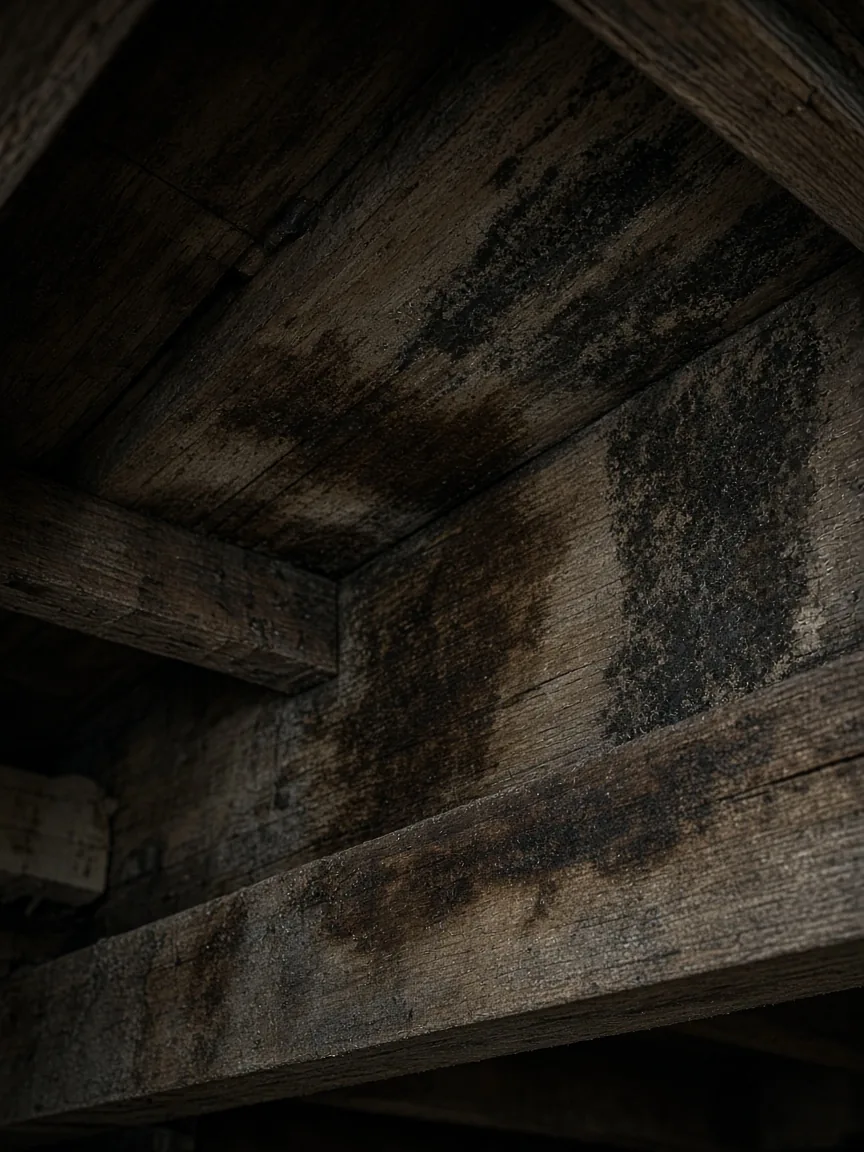
Crawl space mold and musty odors in Kansas City come from moisture, so the lasting fix is to stop the water and humidity first and clean second, because mold cleaned off damp wood comes back.
The EPA puts it simply in its guide to mold and moisture: moisture control is the key to mold control, and cleaning mold without fixing the water problem means it will likely return. Everything on this page follows from that.
Why a crawl space smells musty
That damp, earthy smell comes from moisture and the growth it supports. In a crawl space the moisture comes from one or more of these:
- Damp soil giving off moisture into the space, especially where the ground is bare or the old plastic is torn.
- Wet insulation that has soaked up water or condensation and stays damp.
- Humid air on cool framing. The DOE Building America Solution Center's guide to unvented, insulated crawl spaces explains that in warm, humid seasons, open vents let in humid air that condenses on cooler joists, more so when the rooms above are air conditioned.
Air moves between the crawl space and the house through gaps around pipes, wires, ducts and the floor itself. That is how a smell under the floor ends up in the rooms above.
Mold on the surface versus wood that is decaying
These are different problems. Surface mold grows on damp wood, insulation and debris. It looks like spots or fuzz and can be cleaned once the moisture is fixed.
Decay goes deeper. Research from the USDA Forest Service's Forest Products Laboratory, Carll and Highley, found that decay fungi generally need wood moisture content above fiber saturation, usually about 25 to 30 percent, and that the long-standing rule is to keep wood below 20 percent. Decayed wood loses strength.
We tell them apart with two tools. The U.S. Department of Housing and Urban Development's Residential Rehabilitation Inspection Guide says sills, joists and beams should be probed for decay: sound wood resists a probe, decayed wood gives way. A moisture meter tells us how wet the wood is now. Decayed framing is a structural repair, covered on our sagging floors page.
What EPA says about testing and "safe levels"
People ask for a mold test first. The EPA guide explains why that is not the useful first step:
- There are no EPA or other federal limits for mold or mold spores, so sampling cannot check a building against a federal standard.
- Sampling is generally unnecessary when mold is visible.
- It is impossible to get rid of all mold and mold spores indoors.
The useful question is not how much mold there is, but where the moisture is coming from.
The order that works: source, dry, clean, seal
- Find and stop the source. Water entry, plumbing leaks, open vents, bare soil. The DOE Building America Solution Center's guide on water management of an existing crawl space floor puts stopping bulk water first. See our guide on drainage before encapsulation.
- Dry it out. The EPA guide says wet materials should be dried within 24 to 48 hours to limit mold growth.
- Clean. Remove wet insulation and debris, and clean surface mold from framing.
- Seal and keep it dry. A vapor barrier, closed vents and a dehumidifier keep the conditions that grew the mold from returning.
How big a job is it
The EPA guide says a moldy area smaller than about 10 square feet, roughly 3 feet by 3 feet, is usually something a homeowner can handle. Larger areas call for more care or a professional. Where mold covers a large area, we will tell you plainly, and the cleaning is handled by a remediation company before the space is sealed. We do not do mold testing or certified remediation.
Smells that encapsulation will not fix
Encapsulation is not a cure for every musty smell. We look for these before recommending it:
- Plumbing or sewer leaks, which need a plumber.
- A dead animal or nesting debris.
- Wet ducts or a blocked HVAC condensate drain, which need the heating and cooling contractor.
- Stored chemicals, paints or fuels, which should not be in a crawl space at all.
If one of these is the source, sealing the crawl space will not help and may concentrate the smell.
After cleanup: keeping the crawl space dry
The goal is a crawl space that stays below the humidity the EPA recommends for indoor spaces, below 60 percent and ideally 30 to 50 percent, with framing that stays dry. That means a sealed vapor barrier, closed vents, and a dehumidifier or other drying method. Our encapsulation page explains the full system.
Mold and odor questions
Is it normal for a crawl space to smell musty?
It is a sign of dampness, and it is worth finding the cause rather than living with it. A musty smell means moisture is supporting growth somewhere under the floor.
Is mold in a crawl space common?
We do not have a reliable statistic, and we will not quote one. The conditions that grow it are well understood: damp soil, humid air condensing on cool wood, and wet insulation.
What can I put in my crawl space to get rid of the smell?
Absorbers, sprays and fresheners treat the symptom. The EPA's advice is to fix the moisture. Once the space is dry, the smell has nothing to feed it.
Do I need a mold test?
The EPA says sampling is generally unnecessary when mold is visible, and that there are no federal limits to test against. Fixing the moisture is the more useful step.
Is crawl space mold dangerous?
The EPA says, in general terms, that molds can produce allergens and irritants and can trigger asthma attacks in people with asthma who are allergic to mold. If you have health concerns, talk to a health professional. For what the work costs, see crawl space encapsulation cost.
Sources
- U.S. Environmental Protection Agency, A Brief Guide to Mold, Moisture and Your Home
- USDA Forest Service, Forest Products Laboratory, Carll and Highley, Decay of wood and wood-based products above ground in buildings (1999)
- DOE Building America Solution Center, Unvented, Insulated Crawlspaces (updated 2021)
- DOE Building America Solution Center, Water Management of Existing Crawlspace Floor (updated 2015)
- U.S. Department of Housing and Urban Development, Residential Rehabilitation Inspection Guide (2000)
Get a musty crawl space looked at
Send photos of the crawl space, any visible mold, and where the smell is strongest. Ask for a crawl space mold and odor quote.